
Top Programming Languages for Web Development
Selecting the right programming language for web development is one of the most crucial decisions when building a website. With hundreds of web development languages available today, finding the one that perfectly fits your project can feel overwhelming.
Every website, whether a personal blog or a large eCommerce portal, depends on the right mix of website programming languages. This choice affects everything: development speed, security, scalability, and even how smoothly users interact with your site.
Web development is much more than just writing code. It’s about combining the right front-end and back-end coding languages to create fast, interactive, and responsive websites. While front-end languages handle what users see, back-end languages manage what happens behind the scenes, data, logic, and performance.
Some of the most popular and trusted website coding languages include JavaScript, Python, PHP, HTML, and CSS. These are the foundations of modern websites and continue to dominate the development landscape in India and worldwide.
In this blog, we’ll explore the best programming languages for websites. You’ll learn what makes each one unique, where it’s best used, and how it can help you build a powerful online presence.
Let’s dive in and discover the top web development coding languages that every developer and business owner should know today.
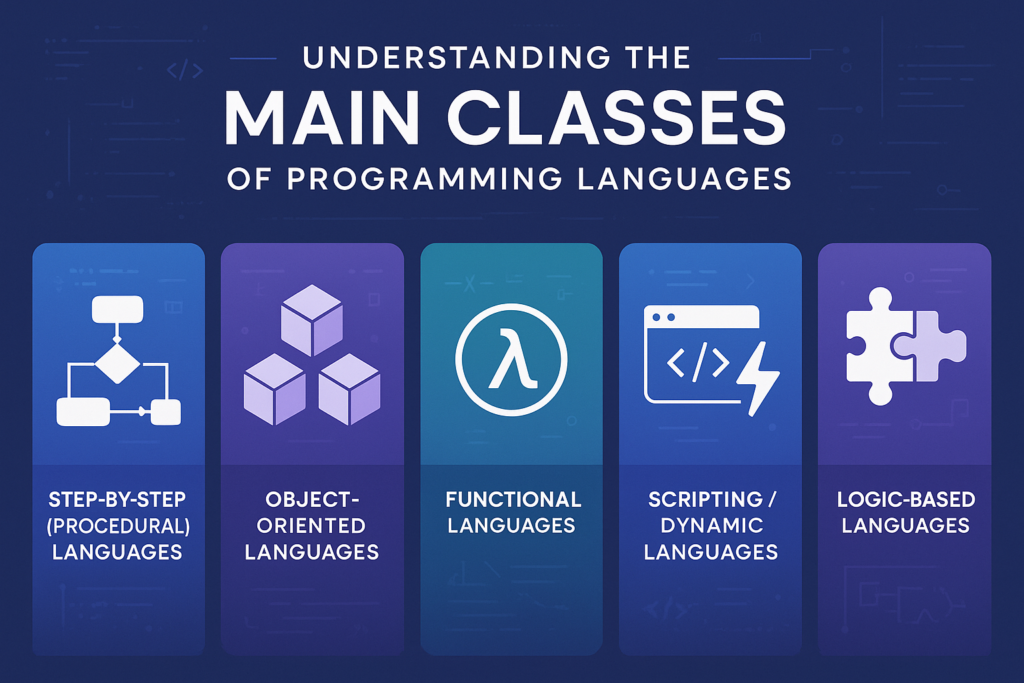
Understanding the Main Classes of Programming Languages
When you’re choosing which website programming languages to learn or use, it helps to know how languages differ by type. Each class has its strengths and fits certain tasks better. Here are the major language classes, explained in a simple way for Indian learners and web-developers.
1. Step-by-Step (Procedural) Languages
These languages break tasks into a sequence of steps. You tell the computer: do this, then that, then that. Examples: C, Pascal, BASIC.
When useful: When you have a clear set of instructions to follow.
Keep in mind: They can get complex when you try to manage many steps or reuse code a lot.
2. Object-Oriented Languages
Here, programs are organised around “objects” which combine data (properties) and behaviour (methods). Languages like Java, C++ and Python support this style.
When useful: When you build websites or apps that have many components, and you want to reuse code or organise it well.
Keep in mind that it takes more thought and structure than simple step-by-step code.
3. Functional Languages
These languages focus on using functions and avoid changing data in place. You write logic in a way that makes outcomes predictable. Examples: Haskell, Scala, Erlang.
When useful: For data-intensive tasks, or when you want less side-effects and clearer logic.
It may feel strange if you’re used to changing variables or doing many steps.
4. Scripting / Dynamic Languages
These are lighter languages, often used to automate tasks or add interaction to websites. Examples: JavaScript, Ruby, PHP (in some cases).
When useful: For quick development, web interactivity, dynamic content or automating parts of your site.
They might not always be as structured or scalable as other types unless you impose good practices.
5. Logic-Based Languages
These languages let you focus on “what” you want rather than “how” exactly to do it. You define rules and the system figures out the logic. For example: Prolog.
When useful: For specialised tasks like artificial intelligence, expert systems, or rule-based engines.
They are less common in everyday web development so you may not encounter them often for typical website work.
Why does this matter for “web development coding languages”?
When you pick a programming language for a website, your choice is often about more than just the language itself. It involves how you think about your project:
- Will you need lots of interactive user interface work (front-end)?
- Do you need complex data logic, many users, heavy server work (back-end)?
- Do you want a language that is easy to learn and quick to deploy?
- Are you future-proofing your website for growth or new features like AI-enabled services?
Knowing these broad classes helps you pick a language (or mix of languages) that fits your website programming language strategy, rather than choosing blindly.
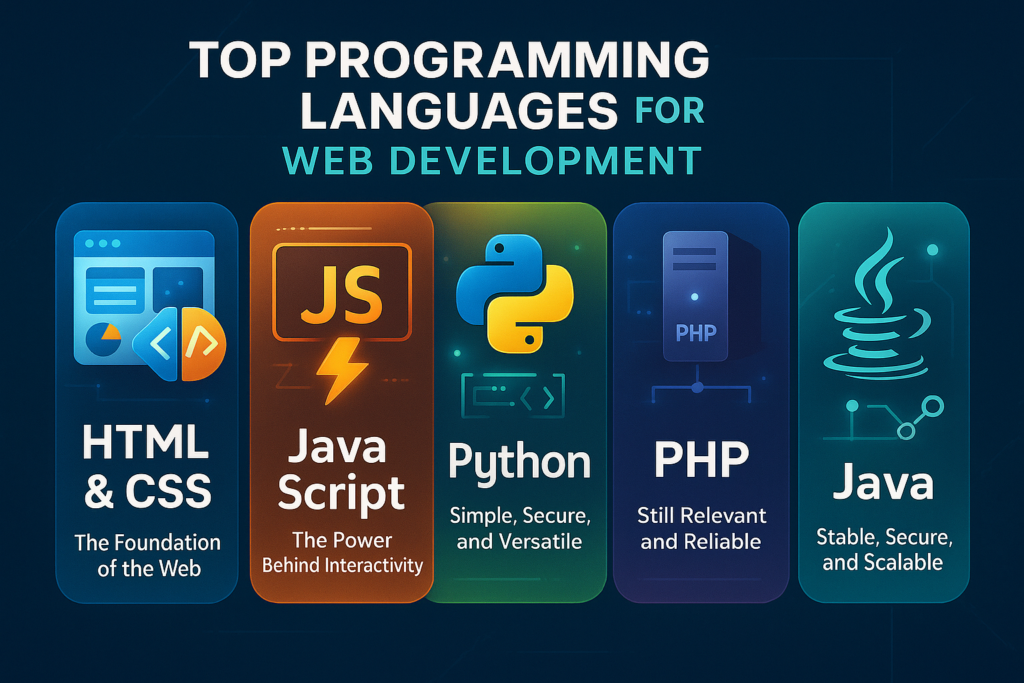
Top Programming Languages for Web Development
When it comes to web development in 2026, a few languages continue to dominate the scene, some for their flexibility, others for their speed, simplicity, or community support.
Let’s look at the top programming languages you should know for building fast, secure, and interactive websites and web apps.
1. HTML & CSS – The Foundation of the Web
Every website starts with HTML (HyperText Markup Language) and CSS (Cascading Style Sheets).
HTML structures the web page, while CSS makes it look appealing and responsive. These two are not “programming” languages in the traditional sense, but they are essential for front-end design.
Modern CSS frameworks like Tailwind CSS and Bootstrap 5 make styling faster and more consistent. With CSS Grid and Flexbox, developers can now build adaptive layouts without heavy coding.
Advantages:
- Simple to learn and use
- Loads quickly on any device
- Works on all major browsers
- Free and open source
- Integrates well with JavaScript and other tech
Disadvantages: - Limited interactivity
- Can get lengthy for large projects
- Security depends on the server setup
HTML and CSS form the backbone of the web. Every developer should master them before moving on to dynamic languages.
2. JavaScript – The Power Behind Interactivity
If HTML and CSS are the structure and style, JavaScript (JS) brings the site to life. It makes websites dynamic, interactive, and smarter. From buttons that respond instantly to animations and dashboards, JavaScript powers it all.
In 2026, JavaScript will remain the most used language globally (Stack Overflow 2024 Survey). It works both on the front-end and back-end (thanks to Node.js), making it ideal for full-stack developers. Popular frameworks like React, Vue, and Next.js keep evolving to simplify development and improve performance.
Advantages:
- Fast and efficient
- Runs on both client and server
- Huge community and library support
- Integrates easily with HTML and CSS
- Enables responsive, dynamic interfaces
Disadvantages: - Requires browser support
- Debugging asynchronous code can be tricky
- Can pose security risks if not coded carefully
JavaScript makes the web interactive and intelligent. It’s a must-learn for any modern web developer.
3. Python – Simple, Secure, and Versatile
Python has become a favourite for developers because of its clean syntax and flexibility. It’s widely used in web development, AI, data analysis, and automation.
With frameworks like Django and Flask, building secure and scalable web apps is easier than ever.
Python’s popularity continues to rise thanks to its role in AI-powered websites and machine learning-based user experiences.
Advantages:
- Easy to learn and read
- Huge library ecosystem
- Works well with AI and data tools
- Encourages clean and readable code
- Excellent community support
Disadvantages - Slower than low-level languages like C++
- Memory-heavy for large-scale apps
- Runtime errors can occur due to dynamic typing
Python is perfect if you want clean, maintainable code and AI-ready websites.
4. PHP – Still Relevant and Reliable
Despite being over two decades old, PHP continues to power over 75% of websites with a backend (W3Techs, 2026). It’s the backbone of platforms like WordPress, Facebook (initially), and Wikipedia.
Modern PHP frameworks such as Laravel and Symfony make development faster, more secure, and efficient.
Laravel, in particular, is loved for its elegant syntax and built-in tools for authentication, caching, and routing.
Advantages:
- Open source and free to use
- Easy setup and quick deployment
- Works seamlessly with HTML
- Huge developer community
- Fast and platform-independent
Disadvantages:
- Can face security issues if not coded properly
- Lacks advanced debugging tools
- Code structure can get messy in large projects
PHP remains a reliable and beginner-friendly option for dynamic websites and CMS-driven platforms.
5. Java – Stable, Secure, and Scalable
Java continues to be one of the most powerful backend languages in 2026. It’s heavily used for enterprise systems, Android apps, and large-scale web solutions.
With frameworks like Spring Boot and Hibernate, Java developers can quickly build secure, high-performance applications. It’s also highly portable – “write once, run anywhere” remains its key strength.
Advantages:
- Secure and reliable
- Platform-independent
- Great for large enterprise apps
- Supports multithreading for better performance
- Rich libraries and tools
Disadvantages: - Verbose syntax
- Slower than lightweight languages like Node.js
- Not ideal for beginners
Java is the go-to choice for businesses that prioritise performance, stability, and scalability.
How to Pick the Right Programming Language for Web Development?
Choosing the most suitable web development language isn’t just about following trends, it’s about aligning technology with your project goals, performance expectations, and team capabilities. The right decision can save time, reduce costs, and simplify maintenance in the long run. Here’s a simple yet effective guide to help you make the best choice:
1. Ease of Learning and Adoption
Every new programming language comes with its own learning curve. If your development team is already comfortable with a specific language that fits your project goals, it’s often wise to stick with it. However, if you’re building a new team or starting from scratch, opt for languages that are easy to learn and widely adopted, such as Python or JavaScript, to speed up onboarding and productivity.
2. Active Developer Community
A strong community means better access to help, resources, libraries, and updates. Choosing a language backed by an active global community ensures continuous improvement and faster troubleshooting. For instance, JavaScript and Python boast massive developer bases, making it easy to find tutorials, plug-ins, and solutions for nearly any challenge.
3. Built-in Security and Reliability
Security should always be a top priority, especially when developing web apps that handle user data or payments. Go for languages and frameworks with built-in security features or regular updates that address vulnerabilities. In 2026, Java, Ruby on Rails, and ASP.NET Core remain strong choices for projects needing robust protection and compliance.
4. Cost Efficiency and Licensing
Budget plays a big role in language selection. Some languages and frameworks are completely open-source, while others may require commercial licenses or premium tools. When estimating costs, factor in not just the licensing but also hosting, maintenance, and developer training. Open-source languages like PHP and Python continue to dominate due to their affordability and wide tool support.
5. Long-term Maintenance and Support
Your website isn’t a one-time build, it needs regular updates, bug fixes, and scalability improvements. Choose a programming language that offers long-term stability, frequent updates, and an ecosystem rich in libraries and extensions. Also, ensure that skilled developers are readily available in your region for ongoing support. Languages like JavaScript, PHP, and Python are known for their maintainability and extensive community-driven enhancements.
Final Thoughts
Choosing the right programming language for web development in 2026 is no longer about finding a single “best” option, it’s about selecting the one that aligns with your project goals, team expertise, and long-term growth. Every language has its own strengths: HTML, CSS, and JavaScript remain the core trio for building visually appealing and interactive websites, while Python, PHP, and Java continue to lead the back-end development space with their scalability, flexibility, and ease of integration. With the rapid evolution of frameworks, AI-assisted coding, and cloud-based solutions, developers today have more choices and power than ever before.
What truly matters is how well your chosen language fits into your project’s ecosystem, whether it’s a simple business website, a large eCommerce platform, or an AI-driven web app. A thoughtful choice not only accelerates development but also ensures a smoother user experience and long-term stability. As technology continues to evolve, staying adaptable and updated with the latest trends in programming languages will help you remain ahead in the ever-changing world of web development.
Frequently Asked Questions
Q1. Which programming language should we learn first for web development?
Start with HTML and CSS, they’re essential for the structure and design of any website. Then learn JavaScript to add interactivity. Once you’ve got that foundation, you can pick a back-end language (Python, PHP, Java) based on your interests and project needs.
Q2. Can one language cover both front-end and back-end web development?
Yes, to a large extent. For example, with JavaScript you can code both the browser side (front-end) and the server side (using Node.js). But even when you do that, your project may still benefit from using specialised languages or tools for performance, database work or scalability.
Q3. What languages are in highest demand for web developers in 2026?
According to industry surveys, the most sought-after languages include Python, JavaScript and Java. These languages offer wide use-cases, strong community support and good job prospects.
Q4. How do we choose between multiple back-end languages like Python, Java or PHP?
Here are some guiding points:
- Choose Python if you want simplicity, readability and potential for AI/data features.
- Choose Java for enterprise-level applications, strong scalability and long-term maintainability.
- Choose PHP if you’re working with CMSs, web content projects or rapid deployment with a lower budget.
Evaluate your team’s skillset, your web project’s future growth and technical demands before deciding.
Q5. Will the language we pick today still be relevant in a few years?
While no language is guaranteed to dominate forever, many core languages remain stable over time due to community strength, library support and widespread usage. For example, Python and JavaScript continue to top popularity lists in 2026. That said, keep learning as the web evolves, new languages, frameworks and tools (for AI, performance or edge-computing) are always emerging.