Headless Commerce in Adobe Commerce: A Game-Changer for Retail Brands
Today, online shopping has changed dramatically. Customers want fast, consistent, and personalized experiences across websites, apps, social networks, and even smart devices. Traditional e-commerce platforms often struggle to keep up. They are rigid, slow to adapt, and too attached to one type of user experience. That’s why headless commerce has become so important.
With Adobe Commerce headless commerce, retail brands get the freedom to build shopping journeys that truly fit modern customer needs. You can sell on any channel. You can design frontends that feel more like apps. And you can test, launch, and change experiences much faster, without even touching the backend.
Using Adobe Commerce headless platforms, brands can further control and scale their brands using APIs. Whether you’re building for mobile-first users, virtual showrooms, or immersive AR experiences, headless commerce gives you the power to deliver seamless shopping wherever you go.
The future of retail isn’t about having an online store; it’s about delivering smarter retail experiences. Retail headless ecommerce is how future-ready brands are doing it. This blog explores how Adobe Commerce headless solutions enable retail brands to grow faster, personalise better, and lead multichannel campaigns.
Understanding Headless Commerce with Adobe Commerce
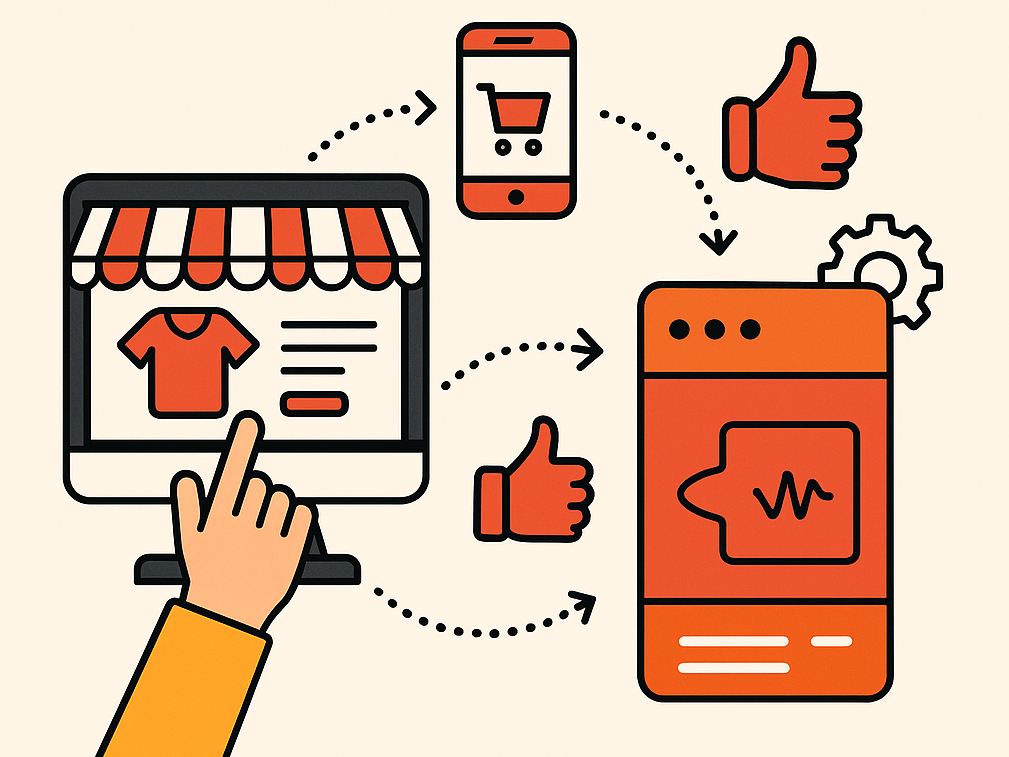
Headless commerce is a smarter approach for creating modern eCommerce experiences. Instead of keeping the front end (where customers shop) and the back end (where the business logic lives) tightly coupled, headless commerce breaks these apart, allowing for them to operate independently.
This allows retailers more control. You can change your design, launch new channels, or define custom storefronts, without having to change your commerce engine. That flexibility is only available in Adobe Commerce’s headless commerce.
What is Headless Commerce?
Headless commerce means disconnecting the customer-facing layer (the “head”) from the operational backend (the “body”). It’s called “headless” because your front end works on its own. That opens up creative freedom for developers and marketers alike.
Front end: You can fully customize how the site looks and feels to your customers.
Back end: Handles things like order processing, payments, inventory, and user accounts.
How Does Headless Commerce Work?
The secret behind headless commerce is API-first architecture. APIs (Application Programming Interfaces) are the messengers between your front end and back end. They pass data between systems in real time, making it possible to sync content, products, prices, orders, and customer info across platforms.
Here’s a quick example:
A customer opens your mobile app to browse a new collection of products.
They add several products in the mobile app, and transition to your desktop site to complete the transaction.
Because of headless commerce, the front end remembers the customer’s actions across devices, with the help of APIs, the backend is updated instantly – stock is updated, payment is processed, and the order is confirmed.
The result is a smooth and connected experience across channels enabled by real-time data and a flexible backend.
Core Components of Adobe Commerce Headless
Here’s what powers a retail headless ecommerce setup using Adobe Commerce:
Adobe Commerce as the Backend
Handles everything behind the scenes, from product catalogues and checkouts to customer data and order management. It’s the stable engine that supports growth and scale.
Flexible Frontend Technologies
You can select from some of the popular frameworks, such as React, Vue.js, or Angular, or take advantage of Progressive Web Apps (PWAs) for speed and app-like experiences.
API-First Architecture
Adobe Commerce uses both REST and GraphQL APIs to enable smooth communication between systems. This keeps your business operations fast, flexible, and future-ready.
Integration-Ready Setup
Easily connect to external platforms such as Adobe Experience Manager, Contentful, or your preferred PIM and CMS tools. Adobe Commerce integrates well with others.
Getting Started – Build Your Headless Commerce Store with Adobe Commerce
So, you’ve decided to go headless. Great move. Here’s a practical roadmap to help you create a flexible, scalable Adobe Commerce headless commerce solution that delivers real results for modern retail.
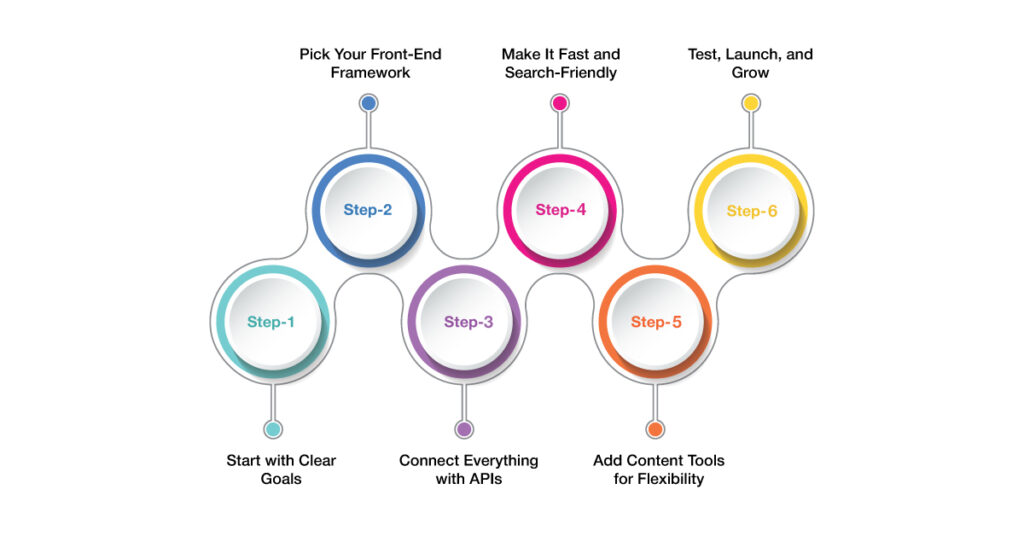
Step 1) Start with Clear Goals
- Rather than launching blind, ask yourself what you want to achieve. It might be a faster site speed, improved mobile experience, or better omnichannel experience.
- Establish your business goals upfront, and they will inform your decisions.
Step 2) Pick Your Front-End Framework
- This is where creativity comes in.
- Choose your frontend tech, React, Vue.js, or Angular are all strong options.
- Want a faster start? Try Adobe PWA Studio, built to help you launch
Progressive Web Apps quickly and efficiently.
Step 3) Connect Everything with APIs
- That’s where Adobe Commerce headless stands out.
- Its API-first structure uses REST and GraphQL APIs to connect your front end and back end.
- That means easy updates, data streams, and the freedom to build what and where you want.
Step 4) Make It Fast and Search-Friendly
- Speed is key for users and search engines.
- Use server-side rendering (SSR) to help your content get indexed properly.
- Reduce sluggish load times on image-heavy pages by using lazy loading, compressing media files, and minifying your code. Every second makes a difference.
Step 5) Add Content Tools for Flexibility
Great storefronts need great content.
Plug in tools like Adobe Experience Manager (AEM), Contentful, or your preferred CMS.
This lets your marketing and content teams update pages fast, without needing a developer.
Step 6) Test, Launch, and Grow
Before going live, test everything.
Check how APIs behave. Look at caching. Monitor how your data flows between systems.
Once live, the retail headless ecommerce model makes it easier to scale, adapt, and expand your business as it grows.
Why Are More Retail Brands Going Headless with Adobe Commerce?
A headless commerce platform from Adobe Commerce is an intelligent way to build fast, flexible, and future-proof retail experiences. For brands that want to scale without slowing down, it’s a clear win with seamless multichannel shopping, stronger performance, and easier development. Invest in Adobe Commerce if you’re planning to grow, personalize, and future-proof your digital presence.
Let’s break down what makes this approach a true competitive advantage for modern retail:
Blazing-Fast Performance That Boosts Conversions
Page speed isn’t only a matter of convenience; it can be the difference between them clicking away from your store or clicking to checkout. Slow sites push customers away, and fast experiences prompt them to purchase. By separating the frontend from the API, Adobe Commerce headless allows developers to optimize performance without even touching the back office core operations. Here’s how:
Use frontend frameworks like Next.js, Vue, or React to build fast, mobile-friendly experiences.
Leverage lazy loading, image optimization, and server-side rendering (SSR) to reduce load times and improve your SEO.
When you use APIs smartly, the frontend will only request data that it needs, keeping the storefront fast and light.
The improvement in speed boosts your Core Web Vitals, which will have a direct impact on your search engine rankings and bounce rates.
Built for Omnichannel Commerce
Whether your customers are shopping on a mobile application, laptop, smart speaker, or even a kiosk, Adobe Commerce headless ensures they have a consistent experience. This multichannel flexibility is essential for modern retail brands looking to remain competitive and customer-centered.
One unified backend powers all your digital touchpoints.
Inventory, pricing, and product data stay synchronized across web, mobile, POS, and more.
Easily connect with third-party platforms like Instagram, TikTok, Amazon, and WhatsApp for broader reach.
Personalization That Connects
Shoppers today want brands to “get” them, and headless commerce makes it possible to deliver. With decoupled architecture, brands can customize how their site looks and behaves for different audiences without slowing things down.
Offer personalized recommendations, AI-based recommendations, and personalized messaging based on location or behavior.
Conduct experimentation like A/B testing without any backend work.
API connectivity to CRMs, segmentation offers, and marketing automation is simple.
This level of personalization increases marketing engagement, customer loyalty, and long-term growth.
Developer Freedom and Faster Innovation
With headless, your tech team finally gets the flexibility they’ve always wanted. And since Adobe Commerce supports both REST and GraphQL APIs, building custom apps or mobile storefronts becomes easier and more efficient.
You can use any tools and stacks you prefer without restriction.
Having the ability to deploy changes separately to the frontend and backend reduces the time spent on changes and limits bugs.
Your store scales faster by reusing components, and development durations are shorter, so you can spend less time managing configuration.
Scalable, Future-Ready Architecture
One of the biggest advantages of headless is flexibility. With new technologies coming in like AI chatbots, augmented reality (AR), virtual try-ons, or voice assistants, your platform will be ready to plug them in.
API-first infrastructure means that as your business grows, you can integrate new tools without any inconvenience.
Adobe Commerce’s modular architecture will allow for easy upgrades and new features to be added to the software in the future.
Brands don’t have to reinvent their design, expand to new geographies, or add new sales channels.
Smooth Content and CMS Integration
Great content drives great commerce. This means marketing teams can create, edit, and launch campaigns without waiting for developers, speeding up execution all around. Adobe Commerce provides the tools to bring your stories and shopping together:
Use Adobe Experience Manager (AEM) to manage content across multiple devices and channels.
Or plug in popular CMSs like WordPress, Drupal, or Contentful to power your frontend.
Combine content with commerce dynamically, without slowing down your site.
Adobe’s PWA Studio – Your Mobile Advantage
Mobile shoppers now lead the pack, and expectations around mobile speed, usability, and personalization are sky-high. That’s where Adobe’s PWA Studio gives brands a strong competitive edge. PWA Studio includes ready-to-use tools and templates, helping developers launch mobile-first storefronts faster than ever.
Build app-type shopping experiences that are fast, secure, and SEO-friendly.
PWAs load fast, even in low-connectivity situations, and have offline capabilities.
They are also discoverable, and easy to find through search engines, and easy to promote and share.
Key Takeaways:
Headless commerce separates the frontend from the backend, providing unparalleled flexibility for design and development.
Adobe Commerce has a powerful, API-first backend that is ideal for headless builds.
Using programs like Next.js and Nuxt.js, backend programmers create superfast, responsive digital storefronts.
Headless systems help enhance performance, user experience, and omnichannel delivery.
They also make it easier to integrate with new technologies like voice search, AR, and AI tools.
Conventional Adobe Commerce usually provides merchants with a complete solution out of the box with lower upfront complexity.
Headless architectures often require a larger initial investment, but offer long-term ROI and scalability.
It’s easier to manage your multi-channel and personalised experiences in a headless environment.
Continues to provide strong security across both models, but the implementations differ.
Decisions between headless or standard setups often depend on your business size, required agility, content strategy, and digital growth strategy.
Final Thoughts – Future-Ready Commerce Starts with the Right Architecture
For businesses to succeed in digital commerce, they need more than just a good product. They need the ability to adapt, the tools to innovate, and the ability to deliver seamless experiences across channels.
Using a headless commerce platform lets brands decouple the user experience from backend logic. When coupled with Adobe Commerce, it allows for scalability, personalization, and omnichannel sales.
For some businesses, however, going headless isn’t the best option. Adobe Commerce’s traditional setup may provide a more comprehensive set of features out of the box, perfect for quicker time-to-market and easier operational requirements.
Whether you are just starting your digital journey or ready to redesign your entire stack, it all comes down to what your business needs today and tomorrow.
Why Choose IDS Logic for Adobe Commerce & Headless Implementation?
As a trusted Adobe Commerce development company, IDS Logic aligns technology with your growth strategy. As a headless architecture expert, we bring deep knowledge of headless architectures to the table.
Our team works alongside you to identify the best commerce model for your business, which meets your current goals while setting you up for long-term growth.
Let’s build something future-proof.
Get in touch with us to find out how Adobe Commerce and headless architecture can help you drive your next stage of digital growth.
Frequently Asked Questions
Q1) Does Headless Commerce work well with Progressive Web Apps (PWAs)?
Certainly. Headless commerce works exceptionally well with PWAs. Using PWA Studio, you can create app-like experiences on the web, with fast loading, offline access, push notifications, and responsive design, all the while maximizing the flexibility of a decoupled frontend.
Q2) How long does it typically take to implement a Headless Adobe Commerce Setup?
The timeline depends on how complex it is to implement, the integrations you would like to implement, and what frontend technology you will be using. Generally, a headless Adobe Commerce implementation is a longer process of 3 to 6 months when compared to a traditional build. That is primarily because a headless implementation has custom functions and performance tuning, as well as leverages any third-party services.
Q3) Can Headless Commerce improve checkout conversion rates?
There is no doubt that headless architecture enables fully customizable and streamlined checkout processes, reduces form fields, loads components asynchronously, and integrates one-click payments. With these improvements, conversion rates can be increased, and cart abandonment can be reduced.
Q4) What are the maintenance requirements for a Headless Commerce Site?
There is greater agility with headless commerce, but it also requires a structured workflow in DevOps and quality assurance. It requires ongoing coordination between frontend and backend teams, regular API version management, and security updates across services.
Q5) Can we use AI and personalization tools more effectively with Headless Commerce?
With headless commerce, advanced AI tools can be integrated directly into the frontend via APIs, such as product recommendation engines, predictive search, and personalized content delivery. You can test and deploy personalized experiences faster without disrupting core commerce functions due to the separation between the backend and frontend.