Top Software Development Trends to Watch out for in 2026
Software development is no longer just a support function. Today, it plays a direct role in business growth, innovation, and decision-making. Companies that invest in the right technologies move faster and compete better.
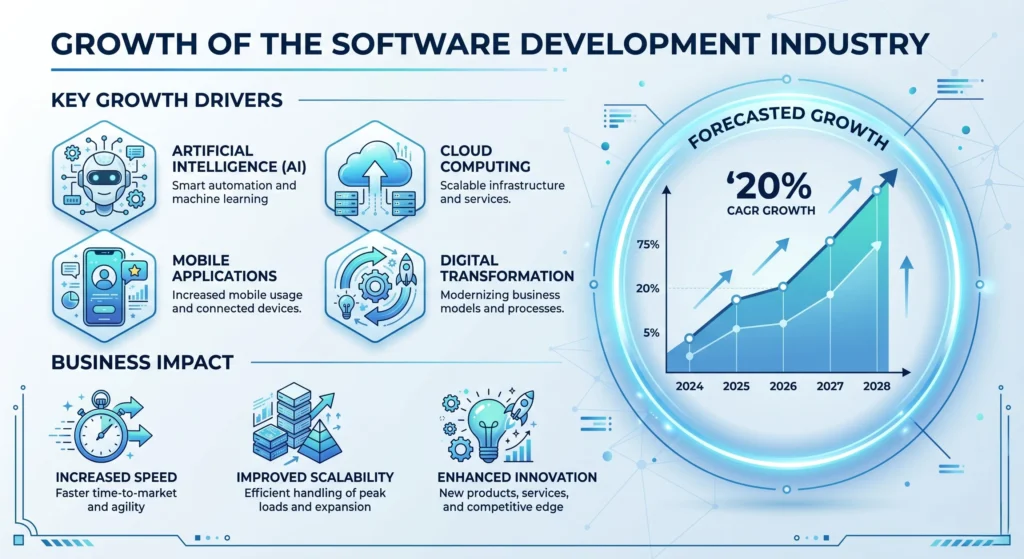
As we move into 2026, the pace of change is accelerating. New tools, frameworks, and development approaches are reshaping how businesses build and scale digital products. In fact, industry reports suggest that the global custom software development market is expected to grow at over 20% CAGR in the coming years. This clearly shows how critical software has become for modern enterprises.
At the same time, customer expectations continue to rise. Users now expect faster, smarter, and more personalized digital experiences. Because of this, businesses can no longer rely on outdated systems or slow development cycles. They need modern solutions that are flexible, scalable, and future-ready.
This is where understanding the latest software development trends becomes essential. From AI-driven development to cloud-native platforms and low-code solutions, the industry is evolving rapidly. These changes are not just technical shifts. They directly impact how businesses operate, innovate, and grow.
Moreover, companies that fail to adapt often face serious challenges. These include rising technical debt, slower time-to-market, and difficulty in scaling operations. On the other hand, businesses that align with software development industry trends gain a clear competitive advantage.
In this blog, we will explore the top software development trends 2026 that are shaping the future. These insights will help you make smarter technology decisions and prepare your business for what’s next.
What Will Custom Software Development Trends Look Like in 2026?
Technology continues to evolve at a rapid pace. As a result, businesses must adapt quickly to stay competitive. In 2026, software development is not just about building applications. It is about creating smarter, faster, and more connected digital experiences.
Today’s users are digital-first. They expect seamless, secure, and personalized interactions across every platform. Because of this shift, businesses must rethink how they approach development. They need flexible systems that can scale and evolve with changing demands.
Understanding the future of software development is now a business priority. Companies that stay updated with software development trends 2026 can plan better, reduce risks, and improve long-term outcomes.
Moreover, custom software development is becoming more strategic. It is no longer limited to building tailored solutions. Instead, it focuses on delivering value-driven systems that align with business goals and customer expectations.
Several key shifts are already shaping the industry. For example, businesses are increasing their focus on automation to reduce manual effort. At the same time, there is a growing demand for multichannel customer experiences across web, mobile, and emerging platforms.
In addition, data privacy and security have become critical concerns. Organizations now prioritize secure development practices to protect user data and maintain trust. Alongside this, disruptive technologies such as AI, cloud-native platforms, and low-code tools are seeing faster adoption across industries.
By understanding these latest software development trends, businesses can prepare early and make smarter investment decisions. More importantly, they can build systems that are ready for the future, not just for today.
Top Software Development Trends 2026 Driving Business Innovation
As businesses move deeper into the digital age, software development continues to evolve rapidly. In 2026, success depends on how well companies adopt modern technologies and align them with business goals.
Today’s users expect faster, smarter, and more secure digital experiences. Because of this, organizations must stay updated with the latest software development trends and act early. Those who adapt quickly gain a strong competitive edge, while others struggle with outdated systems and slow growth.
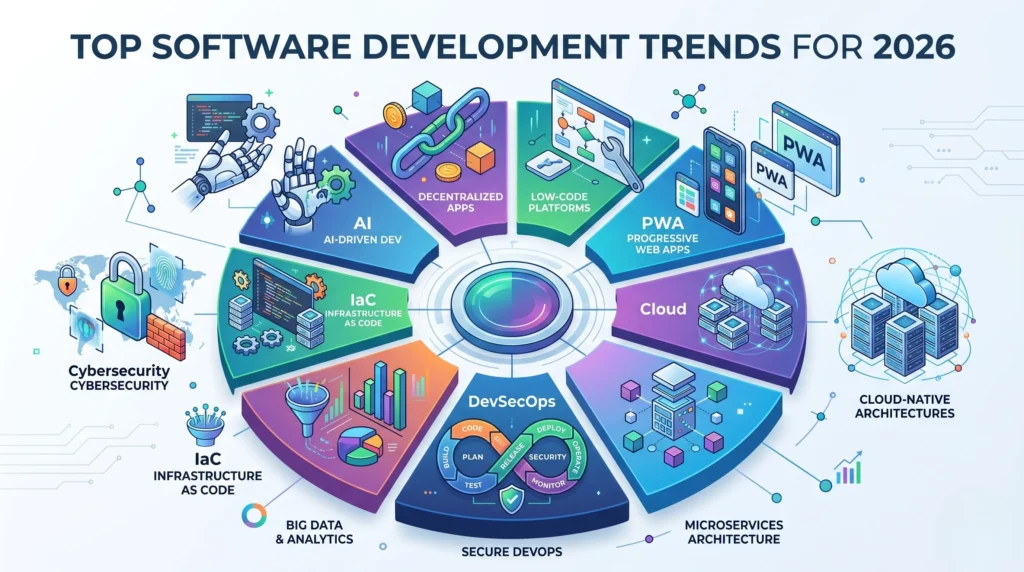
Below are the most important software development trends 2026 that are shaping how businesses build, scale, and innovate.
1) AI-First Software Development
Artificial intelligence is no longer an add-on. It is becoming the foundation of modern software. Businesses are now building AI-first applications where intelligence is part of the core design.
Industry reports suggest that global AI spending will exceed $300 billion by 2026. At the same time, most organizations are moving from AI experiments to real-world implementation.
AI helps businesses:
- Make faster and more accurate decisions
- Deliver personalized customer experiences
- Predict risks and improve operations
For example, AI systems can analyze large data sets to detect patterns, automate workflows, and improve service quality. As a result, AI-driven software is becoming a key part of the future of software development.
2) Blockchain Beyond Finance
Blockchain is expanding beyond cryptocurrencies. It is now used across industries such as healthcare, logistics, and supply chain.
The global blockchain market is expected to grow significantly by 2026. Businesses are adopting it for better transparency, security, and automation.
Key benefits include:
- Secure and tamper-proof data storage
- Transparent and traceable transactions
- Smart contracts that execute automatically
For example, companies can track product origins, verify transactions instantly, and reduce fraud risks. This makes blockchain a valuable part of modern software development industry trends.
3) Rise of Low-Code and No-Code Platforms
Low-code development is transforming how applications are built. Instead of writing long code, teams can use visual tools and pre-built components.
By 2025–2026, more than 65% of applications are expected to be developed using low-code platforms.
This trend helps businesses:
- Build applications faster
- Reduce development costs
- Test ideas with minimal risk
Low-code platforms also help companies deal with developer shortages. They enable faster delivery while maintaining quality, which is why they are a key part of emerging technologies in software development.
4) Progressive Web Apps (PWAs)
Progressive Web Apps combine the best features of websites and mobile apps. They work across devices and offer a smooth user experience.
PWAs are growing rapidly because they:
- Load quickly, even on slow networks
- Work offline and support push notifications
- Reduce development and maintenance costs
Studies show that PWAs can improve user engagement and increase session time. Businesses in eCommerce, media, and travel are already seeing strong results. As user expectations grow, PWAs will remain a strong trend in web and mobile app development.
5) Cloud-Native Development and Cloud Adoption
Cloud computing continues to drive digital transformation. Businesses are shifting toward cloud-native architectures to improve flexibility and scalability.
Cloud-first strategies offer:
- Lower infrastructure and maintenance costs
- Faster deployment and updates
- Easy scalability based on demand
In addition, cloud platforms support modern technologies such as AI, big data, and microservices. This makes cloud adoption essential for businesses looking to stay competitive.
6) Microservices Architecture for Scalable Systems
Microservices are changing how applications are built. Instead of one large system, applications are divided into smaller, independent services.
This approach helps businesses:
- Scale applications easily
- Improve system performance
- Reduce the risk of complete system failure
If one service fails, others continue to work. This improves reliability and ensures better user experience. Microservices remain a key part of modern software development practices.
7) DevSecOps for Secure and Fast Development
Security is now a top priority in software development. DevSecOps integrates security into every stage of development.
This approach helps businesses:
- Identify vulnerabilities early
- Improve software quality
- Deploy updates faster with less risk
With rising cyber threats, organizations cannot afford security gaps. DevSecOps ensures that applications remain secure while maintaining speed and efficiency.
8) Big Data and Advanced Analytics
Data is becoming the backbone of business decisions. Companies now rely on big data and analytics to understand user behavior and improve performance.
The global big data market continues to grow steadily, driven by AI and automation.
Big data helps businesses:
- Make data-driven decisions
- Improve customer insights
- Optimize operations and reduce costs
Technologies such as DataOps and edge computing are also gaining traction. They allow faster data processing and better scalability.
9) Infrastructure as Code (IaC) for Faster Deployment
Infrastructure as Code is changing how businesses manage IT environments. Instead of manual setup, infrastructure is managed through code.
This approach allows teams to:
- Automate infrastructure setup
- Reduce errors and improve consistency
- Speed up development and deployment
IaC also supports DevOps practices such as continuous integration and delivery. This makes it an essential part of modern development workflows.
10) Enhanced Cybersecurity in Software Development
As digital adoption grows, so do security risks. Businesses must invest in strong cybersecurity practices to protect data and systems.
Modern software development now includes:
- Secure coding practices
- Data encryption
- Multi-layer security frameworks
Investing in cybersecurity in 2026 will remain a core component of all development strategies, because it not only protects businesses but also builds customer trust.
How Software Development Trends 2026 Impact Businesses and Developers?
The latest software development trends 2026 are reshaping both how developers work and how businesses operate. Technology is no longer just a support function. It now plays a direct role in growth, innovation, and customer experience. As a result, companies must adapt quickly to stay competitive in an increasingly digital-first world.
Changing Skill Requirements for Developers
As the future of software development evolves, developers must continuously upgrade their skills. Modern development now involves working with AI tools, cloud platforms, and automated systems. Instead of focusing only on coding, developers are expected to solve complex problems and build scalable solutions. This shift requires a strong understanding of cloud-native architecture, security practices, and AI-assisted development. Those who adapt to these changes will stay ahead in the software development industry trends.
Faster Development Cycles and Business Agility
New technologies are significantly reducing development time. Tools like low-code platforms, AI-driven automation, and cloud-based environments allow teams to build and deploy software much faster. As a result, businesses can launch products quickly and respond to changing customer needs without delays. This improved speed not only increases productivity but also helps companies gain a competitive edge. Faster delivery has become a key outcome of latest software development trends.
Security Becomes a Core Development Priority
Security is no longer optional in modern software development. With increasing cyber threats and stricter data regulations, businesses must ensure that applications are secure from the start. Practices like DevSecOps integrate security into every stage of development. This approach helps reduce risks, protect sensitive data, and improve overall system reliability. For both developers and organizations, strong security is now a critical part of emerging technologies in software development.
Empowering Business Teams with Low-Code Platforms
Low-code platforms are transforming how software is created within organizations. Business teams can now build basic applications without depending entirely on developers. This shift allows faster innovation and reduces delays in project execution. At the same time, developers can focus on more complex and strategic tasks. As companies aim to become more agile, low-code adoption continues to grow as part of broader software development industry trends.
Greater Focus on Scalability and Reliability
Modern applications must handle growing user demands without performance issues. Therefore, developers are focusing more on building scalable and reliable systems. Businesses now expect software that can adapt to changing loads, recover quickly from failures, and deliver consistent performance. This ensures better user experience and reduces downtime risks. In today’s competitive environment, reliability is essential for long-term success.
Conclusion
The software development trends 2026 clearly show one thing. Technology is moving fast, and businesses must keep up. From AI-first development to cloud-native systems and low-code platforms, every trend points toward speed, scalability, and smarter decision-making.
These trends are not just technical upgrades. They directly impact how businesses innovate, reduce costs, and deliver better user experiences. Companies that adopt the latest software development trends early can build future-ready systems and stay ahead of competitors.
At the same time, ignoring these changes can lead to outdated technology, slower growth, and higher risks. Therefore, it is important to align your development strategy with the future of software development and invest in modern, scalable solutions.
Partner with IDS Logic for Future-Ready Software Solutions
Choosing the right technology is only part of the journey. Successful implementation requires the right expertise and strategy.
At IDS Logic, we help businesses design, develop, and scale custom software solutions aligned with modern software development industry trends. Our team combines technical expertise with real business understanding to deliver solutions that drive measurable results.
We focus on:
- Building scalable and secure applications
- Integrating AI, cloud, and modern architectures
- Delivering cost-effective and high-performance solutions
- Supporting long-term growth and innovation
Whether you are planning a new project or upgrading existing systems, we can help you make the right technology decisions.
Ready to future-proof your software strategy?
Get in touch with our experts today and turn your ideas into powerful digital solutions.
Frequently Asked Questions
Q1. What are the most important software development trends in 2026?
The most important software development trends 2026 include AI-first development, low-code and no-code platforms, cloud-native architecture, DevSecOps, blockchain, and advanced cybersecurity. These trends are reshaping how software is designed, built, and deployed. For example, AI is helping automate coding and testing, while cloud-native systems allow faster scaling and deployment. Together, these trends enable businesses to build smarter, faster, and more secure applications that align with modern user expectations.
Q2. Why is it important to follow software development trends?
Staying updated with the latest software development trends helps businesses remain competitive in a fast-changing digital environment. When companies adopt modern technologies early, they can improve efficiency, reduce operational costs, and deliver better customer experiences. On the other hand, ignoring these trends can lead to outdated systems, slower innovation, and higher maintenance costs. Following trends also helps businesses plan future investments and avoid unnecessary risks.
Q3. How does AI influence software development in 2026?
AI is transforming how software is built and maintained. In 2026, AI tools assist developers in writing code, detecting errors, and automating testing processes. This reduces manual effort and improves accuracy. Additionally, AI enables businesses to build intelligent applications that can analyze user behavior, predict outcomes, and personalize experiences. As a result, companies can deliver faster services, improve decision-making, and enhance overall user satisfaction.
Q4. What role does cloud computing play in modern software development?
Cloud computing plays a central role in the future of software development. It allows businesses to build, deploy, and scale applications without heavy investment in physical infrastructure. Cloud platforms provide flexibility, cost efficiency, and faster updates. They also support advanced technologies such as AI, big data, and microservices. This makes cloud adoption essential for businesses that want to remain agile and competitive.
Q5. Are low-code platforms replacing traditional development?
Low-code platforms are not replacing traditional development. Instead, they are complementing it. These platforms allow businesses to build simple applications quickly using visual tools, which reduces development time. At the same time, developers continue to work on complex systems, integrations, and advanced features. This balance helps organizations innovate faster while maintaining quality and scalability.
Q6. How can businesses adopt software development trends effectively?
To adopt software development industry trends effectively, businesses should start with a clear strategy. First, they need to evaluate their current systems and identify gaps. Then, they should prioritize technologies that align with their business goals. It is also important to invest in team training and choose the right development partners. A phased approach helps reduce risks and ensures smooth implementation of new technologies.
Q7. What challenges do companies face when adopting new technologies?
Businesses often face challenges such as skill gaps, integration issues, security concerns, and resistance to change. New technologies require proper training and planning, which can take time and resources. In addition, integrating new systems with existing infrastructure can be complex. However, with the right strategy and expert guidance, these challenges can be managed effectively.
Q8. How do these trends improve business performance?
Modern software development trends 2026 help businesses improve performance in several ways. They enable faster development cycles, reduce operational costs, and enhance system reliability. At the same time, they improve user experience through personalization and better performance. Businesses can also make data-driven decisions using advanced analytics. Overall, adopting these trends leads to higher efficiency, better customer satisfaction, and long-term growth.