
AI Chatbot Development Cost in 2026 – Complete Breakdown, Pricing Models & ROI Guide
Some Quick Facts
Here’s a simple breakdown to start with:
- In 2026, building an enterprise-grade AI chatbot can cost anywhere from ₹35 lakh to ₹3.2 crore, which translates to about USD $45,000 on the lower side and can go up to nearly USD $380,000 for advanced, fully integrated systems.
- Chatbot pricing models differ depending on whether you choose a pre-trained LLM, a custom-built model, or a hybrid approach.
- Training data, compliance, security needs, and continuous improvements impact the total chatbot development pricing as much as the coding itself.
- Most enterprises recover their AI chatbot ROI within the first year due to lower support costs, faster responses, and higher engagement.
- Smart planning, starting with an MVP and growing step by step, helps companies control enterprise chatbot pricing while improving long-term value.
AI chatbots have evolved far beyond the old scripted tools that could handle only basic questions. Today, they work as smart digital assistants that understand intent, read context, and support natural conversations. They help customers, assist internal teams, automate routine tasks, and even generate personalized responses on the spot. With this rapid shift, almost every enterprise now wants clear answers: how much does it cost to build a chatbot in 2026, and what budget should they plan for? When implemented as part of a broader AI and automation solutions strategy, chatbots deliver far greater long-term value than standalone tools.
The truth is that there is no single figure. The AI chatbot development cost in 2026 can fall anywhere between ₹35 lakh and ₹3.2 crore, depending on the features you need, the level of intelligence, the integrations involved, the training data, and the AI model you choose. For many enterprises, understanding chatbot pricing, AI chatbot pricing models, and enterprise chatbot pricing becomes confusing because the total cost depends on much more than just development.
Companies today choose between pre-trained LLMs, custom AI models, hybrid setups, or complete AI copilots, and each option changes both the upfront investment and long-term ROI. A custom AI chatbot usually costs more than an off-the-shelf solution, but it offers deeper control, better security, and stronger scalability. Industry reports also show that around 70% of large enterprises have already adopted AI chat or copilot systems to automate support and streamline internal communication. To better understand how different AI chatbot solutions for businesses align with real-world use cases, it is important to evaluate both cost and performance together.
A well-planned chatbot often pays for itself quickly. Many organizations recover their AI chatbot ROI within the first year through reduced support workload, faster responses, and improved customer engagement. Smart choices also make a difference. When businesses begin with an MVP, follow structured development timelines, and work with the right chatbot development companies, they avoid overspending and still get a high-performing solution. This impact becomes even stronger when chatbots are combined with AI-powered automation in business operations, where workflows, decisions, and customer journeys are optimized end to end.
This guide gives you a clear and simple breakdown of the AI chatbot development cost in India, the factors that influence pricing, the hidden expenses most companies miss, and the AI chatbot pricing models that suit different business needs. You will also learn how to plan your budget wisely, compare vendors, and build an AI chatbot that delivers long-term ROI.
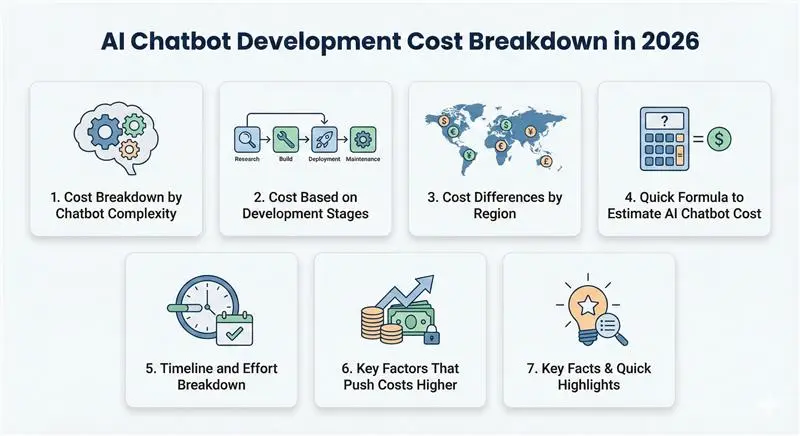
AI Chatbot Development Cost Breakdown in 2026
Understanding the AI chatbot development cost in 2026 is not always simple. There is no single number that fits every project because the final cost depends on what you want the chatbot to do, the type of AI engine you choose, and how deeply it integrates with your existing systems. Instead of guessing a one-line figure, it’s more useful to see how different choices shape your total enterprise AI chatbot cost.
Below is a clean, structured view that explains how the cost moves, why it changes, and what actually influences your budget.
1. Cost Breakdown by Chatbot Complexity
The biggest factor that affects the enterprise AI chatbot development cost is complexity. A chatbot that only answers basic FAQs is far cheaper than a system that uses LLMs, voice, analytics, and deep integrations.
Here’s a simplified view:
- Basic rule-based chatbot costs often begin around $40,000
(limited logic, simple flows, no intelligence). - Mid-level AI chatbot with NLP, intent detection, and CRM integration usually falls between $60,000 and $150,000.
- Advanced AI chatbot with LLM features, custom training, multilingual support, voice capabilities, and analytics can easily cross $300,000–$400,000+.
Why the gap?
Smarter chatbots need more training, more integration work, and longer tuning cycles. Custom model development also increases the cost because it includes data preparation, annotation, and domain-specific testing.
2025 Insight:
Enterprises in India and the US have increased spending on generative AI by 32% year-on-year, especially for LLM-powered chatbots, which directly impacts development cost ranges.
2. Cost Based on Development Stages
Every chatbot goes through a clear development journey, and each phase adds to the overall cost. Understanding these stages helps plan a realistic AI chatbot budget.
Below is the approximate effort and cost share:
Discovery & Planning (10–15%) – Strategy, requirements, user flows, and early estimates. A strong foundation reduces mid-project changes.
Design & Flow Building (10–20%) – UX, conversation design, prototyping, and flow mapping.
AI & NLP Model Work (25–35%) – Training the LLM, fine-tuning, dataset prep, and accuracy checks.
Backend & Integration (20–30%) – Connecting systems like CRM, ERP, ticketing, HR, and security layers.
Testing & QA (10–15%) – Functional tests, real-user behaviour, load testing, and optimisation.
Deployment & Support (Ongoing) – Cloud hosting, monitoring, updates, and model retraining.
Most of the 2026 AI chatbot development cost goes into backend engineering and AI model training, as these define the chatbot’s speed, accuracy, and long-term performance.
3. Cost Differences by Region
The location of your development team can greatly impact the chatbot development pricing. For example, building the same AI chatbot in New York, London, or Bengaluru will give you very different budgets.
Approximate hourly rates:
- United States / Canada: $90–$180/hr
- UK / Western Europe: $70–$140/hr
- India: $25–$60/hr
- Eastern Europe: $40–$80/hr
Because of this, many global companies choose a hybrid model, where strategy stays in-house while development is outsourced to experienced teams in India. It helps reduce the overall enterprise AI chatbot cost without compromising on quality or speed.
2025 Trend:
India remains a leading hub for AI development, with a 28-40% cost advantage over Western markets.
4. Quick Formula to Estimate AI Chatbot Cost
If you’re still at the planning stage, here’s a clean formula to help estimate your initial AI chatbot development cost:
Estimated Cost = (Development Hours × Hourly Rate) + AI Model Fee + Integration Costs + Maintenance Allowance
Example:
2,000 hours × $60/hr = $120,000
AI model licensing ≈ $8,000
Integrations + Maintenance ≈ $12,000
Total = ~$140,000
This formula gives a clearer picture before collecting vendor proposals.
5. Timeline and Effort Breakdown
Most enterprise-grade chatbots follow a predictable build timeline:
- Research & Planning: 2-3 weeks
- Design & Prototyping: 3-4 weeks
- AI Model Training: 6-8 weeks
- Backend, API & System Integrations: 6-10 weeks
- Testing & Optimisation: 3-4 weeks
- Deployment & Support Setup: 2 weeks
A medium-complexity chatbot usually takes 5-7 months. A high-end enterprise chatbot with voice and multilingual support can take 9-12 months.
6. Key Factors That Push Costs Higher
Two chatbots may look similar on the surface but have drastically different cost structures. These are the usual drivers:
Type of AI Engine:
GPT-4, Claude, and Gemini are cheaper to start with.
Custom LLMs cost more but provide tighter control and better privacy.
Training Data Quality:
Industry-specific datasets increase annotation time.
Integrations:
CRM, ERP, HRMS, payment gateways, and ticketing tools add backend load.
Compliance Requirements:
HIPAA, GDPR, and India’s DPDP Act add audits, encryption, and extra security layers.
Cloud Infrastructure:
AWS, Azure, and GCP have different GPU/compute rates.
Multilingual & Voice Layers:
Voice AI and translation models increase AI voice chatbot development cost sharply.
7. Key Facts & Quick Highlights (Summary Section)
Here are some quick takeaways to help you avoid cost surprises:
- 2026 enterprise AI chatbot cost ranges widely between $50,000 and $400,000+, depending on intelligence level.
- Most of the budget goes into AI model training and backend engineering.
- India remains the most cost-efficient region for AI chatbot development.
- Custom LLMs demand more time, higher compute, and deeper testing.
- Advanced chatbots with voice and multilingual support extend the timeline to 9–12 months.
- Compliance and security checks can increase the total cost by 15–25%.
- A simple cost formula helps estimate early budgets without vendor dependency.
- The cost rises as the chatbot moves from scripted flows to self-learning intelligence.
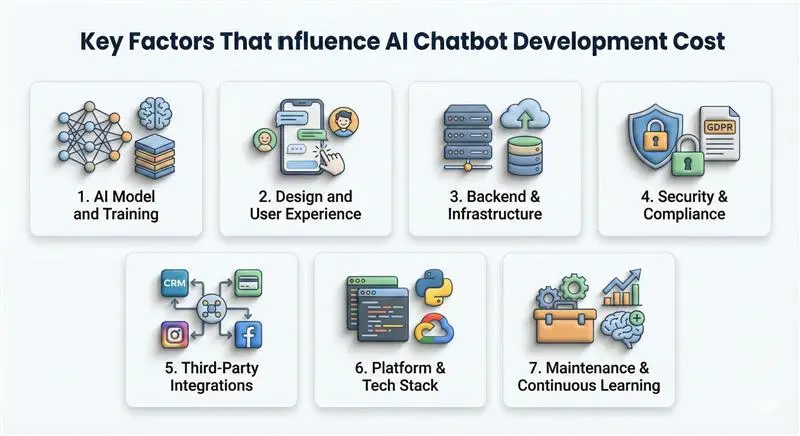
Key Factors That Influence AI Chatbot Development Cost
No two chatbots cost the same. That’s why the cost to build an AI chatbot changes based on the goal, scale, and technology powering it. Below are the key factors that shape your AI chatbot development cost for businesses.
1. AI Model and Training
The smarter the chatbot, the higher the investment.
- Pre-trained models (like GPT-4-class models) cost less to implement.
- Custom AI models require domain data, model tuning, and evaluation – increasing the cost.
When your chatbot learns from specialised business data, the project cost rises.
2. Design and User Experience
Looks matter.
- A simple text-based chatbot is quick and affordable.
- Adding visuals, voice support, multilingual UI, or branded experiences increases design time and cost.
A polished UX boosts engagement – making the extra spend worthwhile.
3. Backend & Infrastructure
Your chatbot runs on APIs, cloud servers, and integration logic.
- More AI features or integrations mean more development hours.
- Using secure, scalable cloud infrastructure also adds to enterprise AI chatbot development costs.
4. Security & Compliance
Highly regulated industries cost more.
- Meeting standards like GDPR, HIPAA, or PDPL can increase budgets by 15-25%.
- Encryption layers, access controls, and audit systems require additional effort.
5. Third-Party Integrations
More connections = higher cost.
- CRMs, ERPs, HRMS, and payment systems add integration time.
- Many third-party APIs also have per-use fees, adding ongoing expenses.
6. Platform & Tech Stack
Where you deploy your bot affects pricing.
- A web-only chatbot is the most affordable.
- Deploying on WhatsApp, Slack, mobile apps, and voice assistants increases development scope.
Advanced NLP and LLM frameworks raise upfront investment but improve long-term ROI.
7. Maintenance & Continuous Learning
Work continues post-launch.
- Regular updates, model retraining, and scaling cost 10-15% of the project value annually.
- Smart monitoring helps your chatbot keep learning and improving.
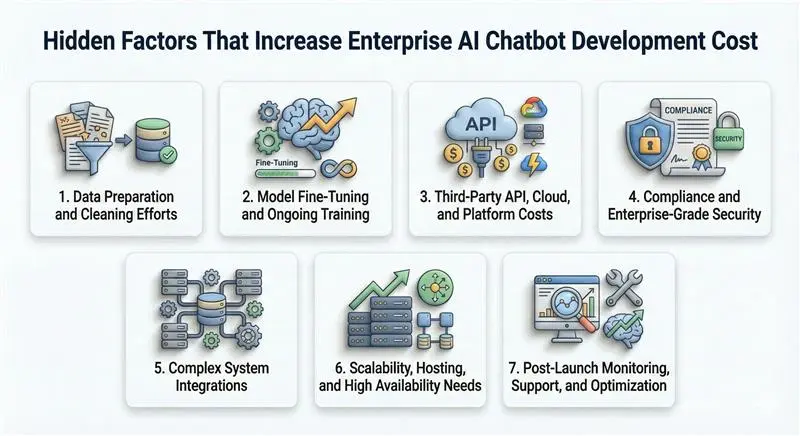
Hidden Factors That Increase Enterprise AI Chatbot Development Cost
Many companies calculate enterprise AI chatbot development cost only on the basis of features or estimated development time. But the truth is, several hidden factors can increase the overall budget by 20-40% if not planned early.
Knowing these hidden cost drivers helps you create a more accurate budget and avoid unexpected expenses during or after development.
Below are the key hidden factors that influence enterprise AI chatbot pricing in 2026.
1. Data Preparation and Cleaning Efforts
No AI chatbot can work properly without clean, structured, and reliable data. Before training begins, your data – documents, FAQs, past chats, product details, or internal knowledgebase, must be:
- Collected
- Cleaned
- Organised
- Labelled
If your organization has inconsistent records, outdated files, or data stored in silos, the engineering effort increases. This extra data preparation time directly adds to the overall AI chatbot development cost.
2. Model Fine-Tuning and Ongoing Training
Training the chatbot once is not enough.
Enterprise chatbots need regular fine-tuning to stay updated with new policies, product changes, customer queries, and business workflows.
This includes:
- Customizing the model with domain-specific knowledge
- Creating new training data
- Improving accuracy over time
- Removing outdated responses
These continuous model updates add recurring operational costs that many companies overlook in the initial budget.
3. Third-Party API, Cloud, and Platform Costs
Most enterprise AI chatbots run on cloud platforms and use external APIs such as:
- LLM APIs (GPT-style models)
- NLP engines
- Payment gateways
- Analytics dashboards
- Speech-to-text or text-to-speech engines
These services charge based on volume, meaning the more your chatbot is used, the higher the monthly cost. As chatbot adoption grows, the platform cost may see a sharp rise.
4. Compliance and Enterprise-Grade Security
Enterprises need strict compliance with standards like:
- GDPR
- HIPAA
- SOC 2
- ISO 27001
- Industry-specific data policies
To meet these requirements, developers must build features such as:
- Encryption
- Secure access controls
- Data masking
- User consent systems
- Audit logs
- Role-based authorization
These add extra development hours and increase the final AI chatbot development budget.
5. Complex System Integrations
Enterprise chatbots rarely work alone. They must integrate with systems like:
- CRM
- ERP
- HRMS
- ITSM
- Internal databases
- Legacy applications
Old systems without APIs or proper documentation often require custom middleware. This technical complexity increases development time and cost.
6. Scalability, Hosting, and High Availability Needs
Enterprises expect their chatbot to work flawlessly:
- During traffic spikes
- Across multiple regions
- 24/7 without downtime
To meet these expectations, developers implement:
- Auto-scaling
- Load balancing
- Multi-region deployment
- Backup and recovery
- Redundancy architecture
These infrastructure needs directly impact DevOps and hosting expenses.
7. Post-Launch Monitoring, Support, and Optimization
Once your AI chatbot goes live, the work does not end. Enterprises must invest in:
- Real-time performance monitoring
- User behaviour analysis
- Quality checks for responses
- Bug fixes and updates
- Model retraining
- Uptime maintenance
- Analytics tracking
These ongoing support activities add monthly and yearly costs that must be included while planning the total AI chatbot budget.
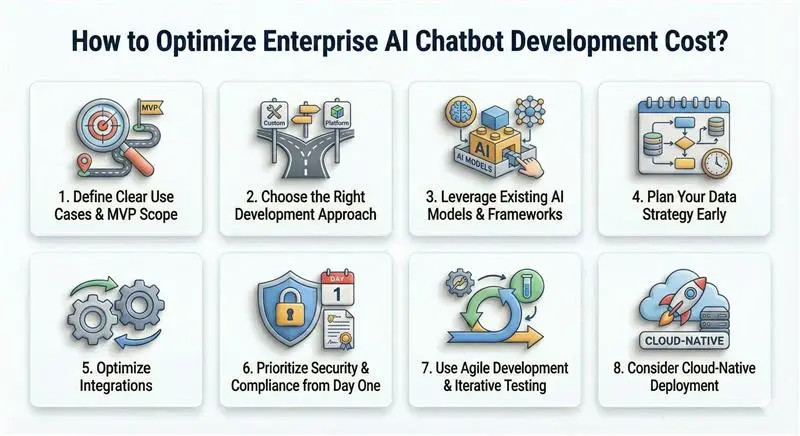
How to Optimize Enterprise AI Chatbot Development Cost?
Enterprise chatbot projects can become expensive if the scope isn’t tightly managed. While the cost may range from ₹40 lakh to ₹1 crore+, smart planning helps you stay within budget without compromising performance or scalability.
1. Define Clear Use Cases & MVP Scope
Start with a minimum viable product focused on high-impact use cases such as customer support, HR self-service, or IT helpdesk. Avoid adding features that are not essential for the first release.
2. Choose the Right Development Approach
- Custom development – Maximum flexibility, but requires strict scope control.
- Pre-built chatbot platforms – Faster and more cost-efficient if they match your needs.
Always evaluate long-term ownership costs before deciding.
3. Leverage Existing AI Models & Frameworks
Using pre-trained NLP models (GPT, Dialogflow, Rasa) cuts development time and expenses. Fine-tuning existing models is usually more cost-effective than building one from scratch.
4. Plan Your Data Strategy Early
Structured, well-labelled data helps prevent delays and rework. A data-first approach lowers training and maintenance costs later.
5. Optimize Integrations
Integrate only the most critical systems in Phase 1. Complex integrations are a major cost driver – prioritize impact over quantity.
6. Prioritize Security & Compliance from Day One
It is far cheaper to build compliant workflows upfront than to retrofit them later. This prevents costly redesigns and deployment delays.
7. Use Agile Development & Iterative Testing
Short sprints, regular testing, and continuous improvements help identify issues early and avoid expensive fixes.
8. Consider Cloud-Native Deployment
Cloud-native infrastructure ensures scalability and reduces infrastructure overhead by letting you pay only for what you use.
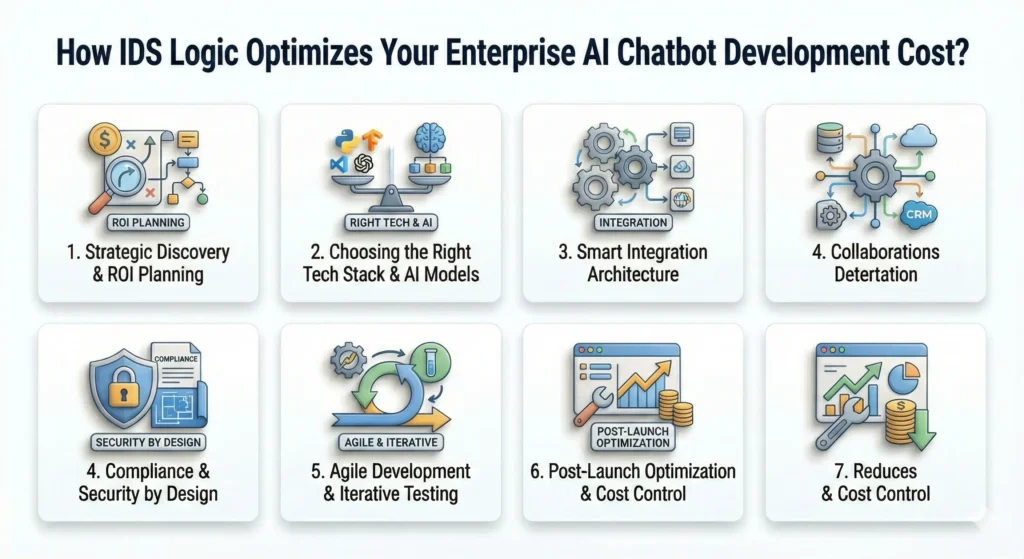
How IDS Logic Optimizes Your Enterprise AI Chatbot Development Cost?
At IDS Logic, we understand that enterprise AI chatbot development cost is shaped by strategy, architecture, and long-term scalability, not just coding. Our approach helps enterprises reduce development costs by 30–40% while delivering high-performance, secure AI chatbot solutions.
1. Strategic Discovery & ROI Planning
We analyze workflows, customer touchpoints, and success metrics to build a lean, high-impact chatbot. This avoids unnecessary features and reduces wasted development time.
2. Choosing the Right Tech Stack & AI Models
We assess whether enterprise chatbot platforms or custom AI models will give the best ROI for your use case. By utilizing pre-trained NLP models where possible, we keep costs predictable and manageable.
3. Smart Integration Architecture
We design modular, API-first integrations to reduce complexity and avoid long-term technical debt.
4. Compliance & Security by Design
We embed GDPR, HIPAA, SOC-2, and enterprise-grade security frameworks from the very beginning, preventing expensive security rework later.
5. Agile Development & Iterative Testing
Through short, efficient sprints, you get early visibility into progress and can validate features without budget overruns.
6. Post-Launch Optimization & Cost Control
We provide ongoing model improvements, monitoring, and optimization to keep operational expenses predictable.
Conclusion
Estimating AI chatbot development cost is not just about numbers, it’s about making a strategic investment in automation and customer experience. With the right planning and execution, an AI chatbot reduces repetitive work, improves response times, and delivers long-term value.
Choose the right use cases, select the right technology, and partner with a team that understands enterprise AI. A well-built chatbot becomes a long-term asset that strengthens productivity, customer satisfaction, and organizational growth.
Ready to Build an Enterprise-Grade AI Assistant?
AI assistants require experimentation, testing, refinement, and strategy, not just code. At IDS Logic, we have deep experience delivering intelligent, scalable, and secure chatbots and enterprise AI solutions across industries.
If your organization is planning to adopt AI-driven virtual assistants or integrate intelligent automation into your systems, our team is ready to support you.
Frequently Asked Questions
Q1. What is the typical cost to build an AI chatbot for businesses?
Developing an AI chatbot for a business usually costs between $18,000 and $45,000, depending on the complexity and the number of features required.
- Basic chatbots with predefined responses fall at the lower end.
- AI-powered chatbots with NLP, analytics, and multiple integrations land in the mid-range.
- Enterprise-grade solutions with voice AI, custom ML models, or omnichannel deployment can exceed $60,000.
Costs also vary based on use cases (customer support, HR, IT helpdesk), scalability needs, and ongoing training requirements.
Q2. How long does it take to develop a fully functional AI chatbot?
Most enterprise chatbots take 8 to 14 weeks from discovery to deployment.
Here’s a rough breakdown:
- Planning & Requirements: 1–2 weeks
- Design & UX: 1–2 weeks
- AI model setup & training: 2–4 weeks
- Integrations & development: 3–5 weeks
- Testing, QA & deployment: 1–2 weeks
More advanced chatbots, especially those involving deep learning or complex integrations, may require additional time for training, iteration, and load testing.
Q3. Which factors influence the final development cost?
Several key elements shape total project cost:
- Chatbot complexity: Basic Q&A bots cost far less than domain-trained AI assistants.
- AI capabilities: NLP, sentiment analysis, generative responses, and voice AI increase cost.
- Integrations: Linking CRM, ERP, HRMS, ticketing, or custom systems often requires custom middleware.
- Data needs: Data preparation, labeling, and model fine-tuning add to cost.
- Security & compliance: Features like encryption, audit logs, GDPR/HIPAA alignment extend timelines.
- Hosting & infrastructure: Cloud usage, compute requirements, and scaling needs impact long-term costs.
Q4. How can companies lower chatbot development costs without quality loss?
Several strategies can help reduce spend while ensuring high performance:
- Start with an MVP: Build only essential features first, then expand based on validated user needs.
- Use pre-trained AI models: Frameworks like GPT or Rasa cut initial development time.
- Limit early integrations: Connect only priority systems; add others post-launch.
- Adopt an iterative approach: Agile sprints help avoid costly rework and allow real-time adjustments.
- Partner with experts: Experienced teams like the one at IDS Logic help optimize architecture and avoid over-engineering.
This phased approach keeps quality high while controlling development and maintenance costs.
Q5. Why should businesses work with a specialist AI chatbot development partner?
A professional development team ensures the chatbot is:
- Secure: Built with enterprise-grade protection, access control, and compliance frameworks.
- Scalable: Capable of handling growth, new channels, and evolving workflow needs.
- Reliable: Tested across edge cases, integrated correctly, and optimized for uptime.
- Aligned with business goals: Tailored to your processes, brand tone, user journeys, and KPIs.
At IDS Logic, every chatbot we develop uses AI to enhance quality, automate workflows, and ensure long-term performance through continuous optimization and monitoring.