How to Choose the Best B2B eCommerce Platform for Your Business
The growth of b2b e-commerce platforms in recent years has been nothing short of remarkable. Companies today are not only looking for the best e-commerce platform but also one that strengthens their brand identity and delivers a seamless buying experience.
The numbers tell the story. Globally, the B2B e-commerce market is already valued at over $12 trillion and is growing by more than 10% each year. In the U.S. alone, it is expected to reach $3 trillion by 2027. In India, the shift is equally dramatic, with wholesale and digital trade expanding at record speed. For businesses, this creates a huge opportunity, but only if they are powered by the right b2b e-commerce solution.
If you sell wholesale, supply products to businesses, or provide enterprise services, a modern b2b platform can transform your operations. It simplifies sales processes, improves customer convenience, and helps teams work more efficiently. Buyers now expect the same smooth experience they enjoy on B2C sites: easy navigation, quick checkouts, custom pricing, and responsive service.
But here’s the challenge: with so many e-commerce software options on the market, from traditional platforms to SaaS and headless solutions, it can be hard to know which one fits your business best. The wrong choice can slow you down. The right one becomes the backbone of your digital identity and a launchpad for future growth.
This guide will walk you through the essential tips to choose the right enterprise e-commerce platform that aligns with your goals, enhances engagement, and sets you up for long-term success.
Let’s dive in.
Why is a B2B eCommerce Platform Essential for Your Business?
In today’s fast-moving digital economy, having the right b2b e-commerce platform is no longer optional, it’s essential. Your online store is often the first impression clients have of your business. It needs to showcase your value, offer smooth navigation, and deliver a checkout process that feels effortless. A clunky site or outdated e-commerce software can easily cost you both buyers and credibility.
Business buyers now expect the same level of convenience they enjoy as consumers. They want quick product searches, personalized pricing, and self-service options available anytime. In fact, recent studies show that more than 40% of B2B buyers prefer self-service portals for managing accounts, requesting quotes, or reordering products. A modern enterprise e-commerce platform makes that possible, reducing friction for customers while freeing up your sales team to focus on higher-value work.
The advantages go even further. With the right b2b e-commerce solution, you can:
- Automate invoices, quotes, and reorders instead of handling them manually.
- Sync data across channels and integrate with ERP or CRM systems for real-time accuracy.
- Offer subscription models or recurring deliveries, giving clients the control they expect.
- Use your site as the central hub for digital marketing, linking ads, campaigns, and content directly to product pages.
The rise of B2B commerce has redefined how companies sell to one another. Once dominated by catalog orders and phone calls, today’s B2B space is fully digital, and growing fast. Global b2b platform sales grew more than 95% between 2020 and 2022, and analysts predict digital sales will soon account for over half of total B2B revenue. That means if your business doesn’t yet have a strong online presence, you risk being left behind.
Simply put: a powerful b2b e-commerce software solution is more than a sales tool. It’s the face of your brand, the hub of your customer experience, and the engine of your future growth.
Tips to Choose the Right B2B eCommerce Platform
Selecting the right b2b e-commerce platform is not just about technology, it’s about building a foundation that can fuel long-term growth. Before diving into features, take time to understand your business needs, customer expectations, and the opportunities you want to unlock. From there, the goal is to find a b2b e-commerce solution that aligns with those priorities and scales with you.
Here are the key factors to consider:
1. Security and Compliance Come First
B2B deals involve sensitive data, pricing contracts, financial records, and client information. Your enterprise e-commerce platform must offer strong security features such as encryption, user-based access, and compliance with global standards like PCI DSS or GDPR. Without this, customer trust and business continuity are at risk.
2. Flexibility and Scalability
B2B orders can range from a few items to bulk shipments worth millions. The best b2b e-commerce software should adapt to both extremes, allowing quick reordering, managing bulk discounts, and handling approval workflows. As your business expands, the platform must be able to grow with you, not hold you back.
3. Ease of Customization
An ideal e-commerce platform is not one-size-fits-all. Look for a solution that supports custom catalogs, buyer-specific pricing, and role-based access. Whether you want to embed a unique design, automate workflows, or offer contract-based catalogs, customization ensures your platform fits your business model, not the other way around.
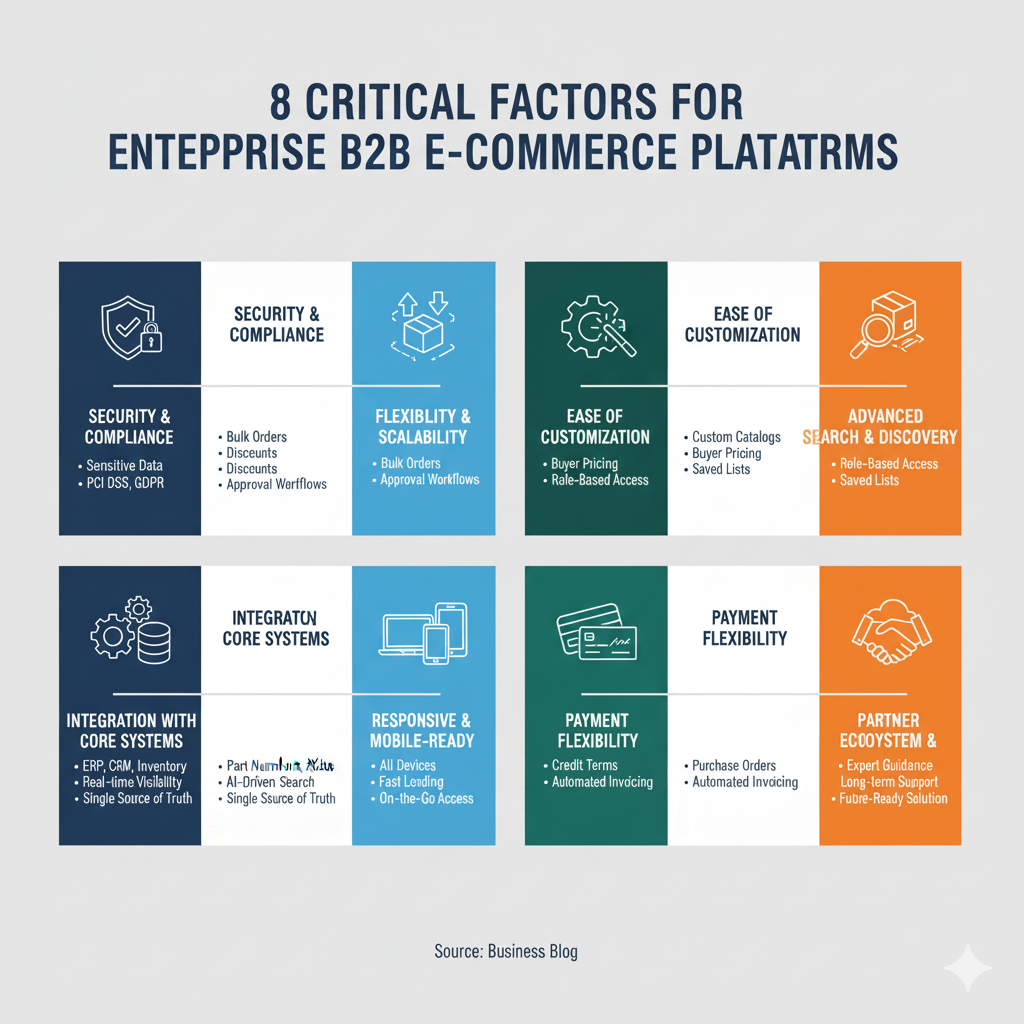
4. Advanced Search and Product Discovery
B2B buyers often shop using part numbers, SKUs, or technical filters. A strong b2b platform should deliver relevant results instantly, powered by AI-driven search and product discovery tools. Personalization, saved lists, and predictive search can speed up the buying process and boost order value.
5. Integration with Core Business Systems
Your e-commerce software should not exist in isolation. Seamless integration with ERP, CRM, inventory management, and accounting tools ensures a single source of truth. This eliminates data silos, reduces errors, and gives you real-time visibility into operations and customer behavior.
6. Responsive and Mobile-Ready Experience
Slow-loading or unresponsive websites frustrate buyers. A modern e-commerce development approach ensures that your platform works smoothly across devices and loads within seconds. Mobile access also enables sales teams and buyers to manage orders on the go.
7. Payment Flexibility
Unlike B2C, B2B transactions often require purchase orders, credit terms, or multi-currency support. A powerful b2b e-commerce solution should offer flexible payment methods while automating invoicing and ensuring tax compliance across regions.
8. Strong Partner Ecosystem and Support
Even the best enterprise e-commerce platform needs expert guidance for deployment and scaling. Choose a provider with a reliable partner ecosystem and long-term support. This will help you minimize costs, adapt faster, and make your solution future-ready.
Why Do Modern B2B Ecommerce Platforms Matter?
Today’s buyers want digital-first interactions. They expect speed, convenience, and personalization at every step. A modern B2B ecommerce platform helps businesses deliver on these expectations while creating room for growth.
Build Stronger Buyer Relationships
Trust is at the heart of B2B. Custom catalogs, contract pricing, and account-specific experiences make buyers feel valued. Over time, this level of personalization boosts retention and loyalty.
Expand Market Reach
Online selling breaks down regional barriers. By going digital, businesses can reach new buyers and expand into new geographies without relying only on traditional sales channels.
Lower Costs and Drive Efficiency
Self-service tools, automation, and AI-powered search reduce the burden on sales and support teams. Instead of handling repetitive requests, your staff can focus on high-value accounts and strategic growth.
Speed Up the Buying Process
Lengthy approval chains and manual pricing updates often slow down B2B transactions. Modern platforms simplify this with automated workflows, instant pricing, and live inventory tracking, helping you close deals faster.
Increase Average Order Value (AOV)
Smarter recommendations, volume-based discounts, and targeted upsells encourage buyers to add more items per order. Businesses using AI-driven ecommerce often see a clear jump in order sizes.
Gain Insights with Better Data
Every search, click, and purchase gives you valuable information. Modern platforms help you track this data, spot patterns, and fine-tune your pricing or product mix with confidence.
Key Trends Defining the Future of B2B Ecommerce
The B2B landscape is moving quickly, shaped by buyer expectations and new technology. Companies that adapt now will stay ahead of the curve.
AI and Smart Automation
Artificial intelligence is becoming the silent sales assistant, powering product recommendations, intelligent chat, and automated quotes. This saves time and makes buying smoother for customers.
A Mobile-First Mindset
B2B buyers want the same convenience they enjoy in B2C shopping. Fast-loading, mobile-ready platforms make it easy to research, compare, and order from any device.
Personalization at Scale
No two buyers are the same. Future-ready platforms allow you to deliver tailored prices, catalogs, and workflows to each account, improving satisfaction and driving repeat purchases.
Omnichannel Experiences
Whether a customer is talking to your sales rep, browsing your website, or using a procurement portal, they expect consistency. Modern platforms connect these touchpoints into one seamless journey.
Connected Commerce Networks
The future isn’t about standalone platforms. It’s about ecosystems that link suppliers, buyers, logistics partners, and financial providers. This connected approach helps businesses navigate supply chain challenges and compliance with greater ease.
Final Thoughts: Choosing the Right B2B eCommerce Platform
Selecting the best B2B eCommerce platform isn’t about picking the tool with the longest feature list. It’s about finding a solution that fits your business model, supports your buyers’ needs, and can scale with your growth. From integration and automation to personalization and mobile readiness, every factor you weigh today will shape the buying experience tomorrow.
The right platform should simplify operations, strengthen customer relationships, and create room for expansion, not add complexity. And while the options can feel overwhelming, having the right partner by your side makes the process easier and far more effective.
At IDS Logic, we help businesses evaluate, implement, and customize B2B eCommerce solutions that align with their goals. Whether you’re moving from legacy systems or building a new digital channel, our team ensures you get a platform that drives long-term success.
Talk to IDS Logic about building your B2B eCommerce strategy and start turning your digital vision into reality.
Frequently Asked Questions
Q1. What role does AI play in B2B ecommerce platforms?
AI now powers search, product recommendations, and personalization. This helps buyers find what they need faster and allows businesses to increase order value while cutting manual effort.
Q2. Can B2B ecommerce platforms support subscription or recurring orders?
Yes. Many platforms now include tools for recurring billing, contract-based orders, and auto-replenishment schedules, which are especially useful for wholesalers and suppliers with repeat clients.
Q3. How important is mobile optimization for B2B ecommerce?
Critical. Business buyers increasingly use mobile devices to compare, research, and order products. A mobile-ready platform ensures you don’t lose sales opportunities from on-the-go decision-makers.
Q4. What are the hidden costs to watch out for when selecting a B2B platform?
Beyond licensing, businesses should consider expenses like customization, integrations, training, ongoing support, and scaling fees. Planning for these upfront avoids budget surprises later.
Q5. How can a B2B platform improve collaboration between sales teams and buyers?
Modern platforms provide shared carts, co-browsing tools, and customer-specific notes. This allows sales reps to stay involved in the buying process digitally while freeing them from repetitive admin tasks.