Magento 1 And Magento 2: A Detailed Comparison for E-Store Owners
Magento has long been one of the most popular eCommerce platforms, powering stores of every size across the globe. As of 2025, Adobe Commerce (Magento 2) continues to hold a significant share in the eCommerce technology market, with thousands of active online stores depending on it to run daily operations. The global eCommerce market itself is projected to hit USD $8.5 trillion by 2030, making platform choice more crucial than ever for online retailers.
For years, many store owners grew comfortable running their sites on Magento 1, but support for it officially ended in June 2020. Despite this, a surprising number of merchants still use Magento 1, exposing themselves to risks like lack of security patches, outdated performance, and higher maintenance costs.
By contrast, Magento 2 (Adobe Commerce) offers modern features like faster page load speed, mobile-first design, stronger security patches, advanced SEO options, and easier third-party integrations. The latest Magento 2.4.8 release in 2025 further enhances checkout, scalability, and API support, ensuring businesses can handle higher volumes and meet customer expectations.
If you’re still deciding between sticking with Magento 1 or making the switch, understanding the key differences between Magento 1 and Magento 2 is critical. In this blog, we’ll break down the most important aspects, performance, security, admin experience, extensions, and costs, so you can make an informed choice and future-proof your e-store.
Magento 1 vs Magento 2: A Quick Overview for E-Store Owners
Before diving into a detailed comparison, it’s important for e-store owners to understand the evolution of Magento and what sets the two versions apart.
Magento 1: The Pioneer of Modern E-Commerce
Magento 1, also known as Magento Community Edition or Magento 1.x, was launched by Varien Inc. on March 31, 2008. It quickly became a favorite for online merchants due to its flexibility and extensive features, allowing store owners to build an e-commerce experience almost like a physical store.
Magento 1’s popularity soared further when Magento Inc. was acquired by eBay in 2011, and later by Adobe in 2015, solidifying its position in the global e-commerce market.
However, Magento 1 reached its end of life (EOL) in June 2020, which means Adobe no longer provides official security updates or technical support. The platform’s last major release was back in 2014, leaving many stores relying on outdated technologies and increasing their vulnerability to performance and security issues.
Magento 2: The Modern, Powerful Successor
Magento 2 was introduced as the next-generation e-commerce platform to address the limitations of Magento 1. Announced in 2010 and officially released in 2015, Magento 2 brought enhanced speed, security, and usability features for modern e-stores.
Built with the latest technologies and optimized for today’s mobile-first, SEO-focused world, Magento 2 empowers merchants with:
- Faster page load times and checkout processes
- Mobile-responsive designs and Progressive Web App (PWA) support
- Enhanced security with SHA-256 hashing and regular Adobe patches
- Improved admin interface for easier product, order, and customer management
The platform continues to evolve, with the latest version, Magento 2.4.8 (2025), introducing over 300 quality fixes, performance improvements, and new features, making it one of the most robust e-commerce solutions available today.
For e-store owners, Magento 2 is not just an upgrade—it’s a complete transformation of the online shopping experience, offering speed, security, and scalability that Magento 1 can no longer match.
Difference between Magento 1 and Magento 2
Choosing the right platform can make or break an online store. Magento has been powering eCommerce for over a decade, but the story of Magento 1 vs Magento 2 is more than just an upgrade, it’s about survival and growth in today’s fast-moving digital market.
Magento 1 officially reached its end of life in June 2020, which means no more official patches, security fixes, or feature updates. Yet, many stores still run on Magento 1, risking outdated performance and higher security threats. On the other side, Magento 2 (Adobe Commerce) has matured into a robust platform that supports the needs of modern businesses in 2025. With Magento 2.4.8 supporting the latest PHP 8.2, advanced caching, SEO tools, and mobile-first design, it is built for speed, scale, and security.
To help store owners understand what really sets the two versions apart, here’s a breakdown of the most important differences.
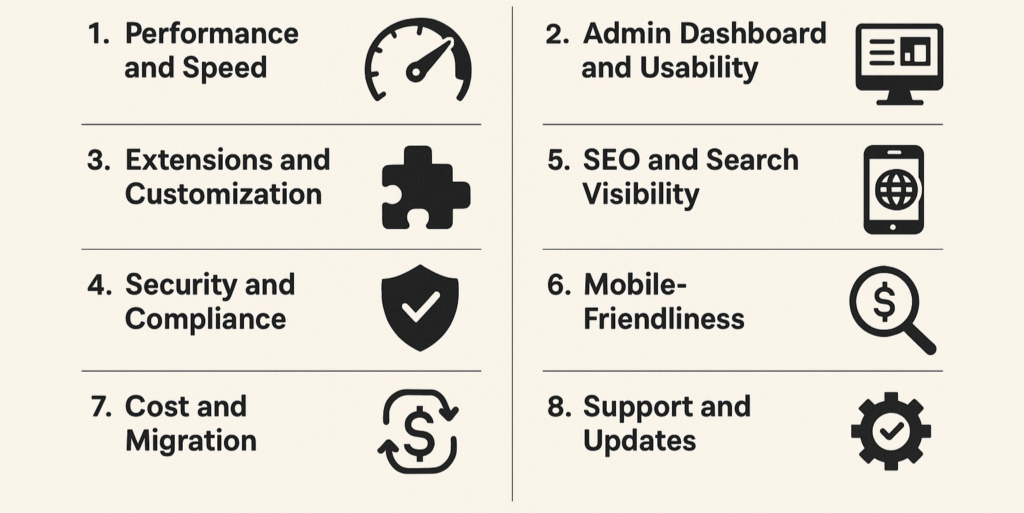
1. Performance and Speed
Performance was Magento 1’s biggest drawback. Stores often suffered from slow load times and heavy server usage. Magento 2 fixes this with:
- Full-page caching and Varnish integration
- Faster checkouts (1.5x quicker, reducing abandoned carts)
- Better server response (handles 39% more orders per hour than Magento 1)
- Optimized JavaScript and CSS for quicker loading
For e-stores, this translates to smoother shopping experiences and better conversion rates.
2. Admin Dashboard and Usability
Magento 1’s admin panel was cluttered and not beginner-friendly. Magento 2 improves with:
- A clean, intuitive dashboard showing lifetime sales, revenue, bestsellers, and recent orders
- Easier navigation across Products, Customers, Marketing, and Content
- Grid management, bulk updates, and CSV exports built-in
- Support for adding product videos, not just images
In short, Magento 2 gives store owners more control with less hassle.
3. Extensions and Customization
Magento 1 relied heavily on third-party extensions, but conflicts were common when two extensions rewrote the same function. Magento 2 solves this with:
- Plugins that overlap code instead of overwriting it
- Simpler installation with modern tools like Composer
- Regular extension updates via the Magento Marketplace
- Higher coding standards, ensuring more reliable add-ons
This makes extending Magento 2 cheaper and less frustrating for merchants.
4. Security and Compliance
Security is where Magento 1 is most vulnerable. Without official updates, it’s exposed to cyber threats. Magento 2, in contrast:
- Receives regular security patches from Adobe
- Uses stronger SHA-256 hashing for passwords
- Meets latest PCI compliance standards
- Actively supports two-factor authentication (2FA)
For store owners handling sensitive payment and customer data, Magento 2 is far safer.
5. SEO and Search Visibility
Magento 1 offered limited SEO support. Magento 2 brings built-in tools that boost visibility:
- Meta tags and SEO-friendly URLs out of the box
- Canonical tags to prevent duplicate content
- Optimized XML sitemaps for search engines
- Mobile-friendly design, now a Google ranking factor
Magento 2 makes it easier for stores to rank higher and attract organic traffic.
6. Mobile-Friendliness
Shopping has gone mobile, with over 60% of global eCommerce sales in 2025 happening via smartphones. Magento 1 wasn’t built with mobile in mind.
Magento 2, however:
- Ships with responsive themes by default
- Features touch-friendly design
- Supports Progressive Web Apps (PWAs) for an app-like experience
- Delivers faster mobile checkouts
This helps merchants capture more sales from mobile users.
7. Cost and Migration
Migrating from Magento 1 to Magento 2 isn’t just an upgrade — it’s a rebuild. Costs depend on:
- Store size and complexity
- Number of extensions and customizations
- Data migration needs
Magento 2 also requires more powerful hosting, but the trade-off is better scalability and lower long-term maintenance costs.
8. Support and Updates
Magento 1 support ended in 2020, leaving store owners dependent on third-party providers. Magento 2, however, is actively supported by Adobe:
- Regular feature releases (latest version: 2.4.8 in 2025)
- Ongoing bug fixes and patches
- A growing developer community focused on Magento 2 only
Simply put, Magento 1 is obsolete; Magento 2 is future-proof
Time to Move: Magento 1 vs Magento 2 Migration
For many store owners still holding on to Magento 1, the question lingers, is it the right time to migrate to Magento 2? The truth is, the ideal time passed when Adobe officially ended Magento 1 support back in June 2020. Yet, in 2025, switching to Magento 2 isn’t just an option, it’s a necessity for survival in today’s eCommerce landscape.
Running an online store on Magento 1 now means living with serious risks. Without security patches or official updates, your site becomes vulnerable to data breaches, slower performance, and outdated extensions. In a market where speed and safety define success, staying on Magento 1 is no longer sustainable.
Why Magento 2 Outshines Magento 1?
Here’s a quick rundown of the key differences between Magento 1 and Magento 2 that make migration worth every effort:
Modern Technology Stack
Magento 2 runs on the latest PHP versions and supports frameworks like HTML5, CSS3, and MySQL 8. This makes your store more stable, scalable, and future-ready.
Performance Boost
Studies show Magento 2 stores load up to 50% faster than Magento 1. Faster page speed directly impacts customer experience and conversions.
Streamlined Admin Panel
The Magento 2 dashboard is cleaner and easier to navigate, reducing the learning curve for store managers and speeding up everyday tasks.
Better Extension Support
Magento 2 is backed by a vibrant marketplace with thousands of updated extensions. Magento 1, on the other hand, has very limited new integrations.
SEO-Friendly Features
Magento 2 includes improved SEO tools like meta tag management, schema markup, and mobile-first indexing support, giving your store better visibility in Google search.
Advanced Security
With two-factor authentication, SHA-256 hashing, and regular patches, Magento 2 is far more secure than Magento 1, which no longer receives updates.
Conclusion – Why Magento 2 Is the Smart Choice for E-Store Owners?
Choosing the right e-commerce platform is critical, and when it comes to Magento, the comparison between Magento 1 and Magento 2 is clear. Magento 2 isn’t just an update, it’s a complete transformation. From faster page loads and streamlined checkout to enhanced security protocols and mobile-first design, it equips e-store owners to meet modern e-commerce demands.
For businesses still on Magento 1, the risks are mounting. Without official updates or patches since June 2020, Magento 1 stores are vulnerable to cyberattacks, performance issues, and compatibility challenges. On the other hand, Magento 2 is actively supported, with continuous updates, advanced features, and a robust ecosystem of extensions designed for growth.
Migrating to Magento 2 doesn’t just improve store performance; it also opens the door to scalable solutions, improved SEO, better customer experiences, and higher conversion rates. In short, Magento 2 empowers businesses to compete in today’s fast-paced online marketplace while future-proofing their operations.
If your goal is to maximize revenue, reduce risks, and provide a seamless shopping experience, Magento 2 is the platform that ensures your store stays ahead of the curve.
Frequently Asked Questions
Q1) Can Magento 2 handle large product catalogs better than Magento 1?
Yes. Magento 2 is optimized for handling large inventories with advanced indexing and caching systems. Stores with thousands of products experience up to 50% faster search and filtering, compared to Magento 1. This makes it ideal for growing businesses that require scalable performance.
Q2) Does Magento 2 support modern payment gateways and integrations?
Absolutely. Magento 2 natively supports popular payment gateways like PayPal, Stripe, and Klarna. Additionally, it is fully compatible with ERP, CRM, and third-party logistics tools, allowing seamless integration for complex business workflows. Magento 1 lacks this level of integration and often requires custom development.
Q3) How does Magento 2 improve customer experience compared to Magento 1?
Magento 2 focuses on speed, responsiveness, and personalization. Features like Ajax cart, one-step checkout, and mobile-first design reduce friction for shoppers, while advanced personalization options help recommend products and promotions based on user behavior, something Magento 1 cannot efficiently offer.
Q4) What are the long-term cost benefits of moving to Magento 2?
While migration requires upfront investment, Magento 2 reduces ongoing costs by offering better server performance, reduced downtime, and fewer conflicts with extensions. Its modern architecture also minimizes the need for custom fixes, making maintenance and scaling more cost-effective over time
Q5) Is Magento 2 future-proof for upcoming e-commerce trends?
Yes. Magento 2 supports Progressive Web Apps (PWAs), AI-driven product recommendations, and multi-channel selling. These features allow stores to stay competitive with evolving shopping habits, ensuring your platform remains relevant for years to come, something Magento 1 cannot promise due to outdated architecture.